
Control the Brand: A Trademark Strategy Book
Or Lose It.
A trademark strategy book by Ruben Alcoba on how brands control pricing, distribution, licensing, and long-term business value.
Control the Brand reframes trademarks as a system of control over pricing, distribution, licensing, expansion, and long-term business value for founders, brand owners, Amazon sellers, and operators building something meant to last.
What is Control the Brand?
Control the Brand by Ruben Alcoba is a trademark strategy book for founders, Amazon sellers, brand owners, and operators who want more than a filing. It explains how trademarks influence pricing power, distribution control, licensing discipline, and long-term business value.
Unlike a basic legal guide, this book frames trademarks as a business system. It helps readers understand how stronger brand structure creates leverage, protects margins, improves negotiating position, and supports expansion. The page also connects readers who need legal strategy to MiamiPatents.com.
Available on Amazon: Control the Brand by Ruben Alcoba.
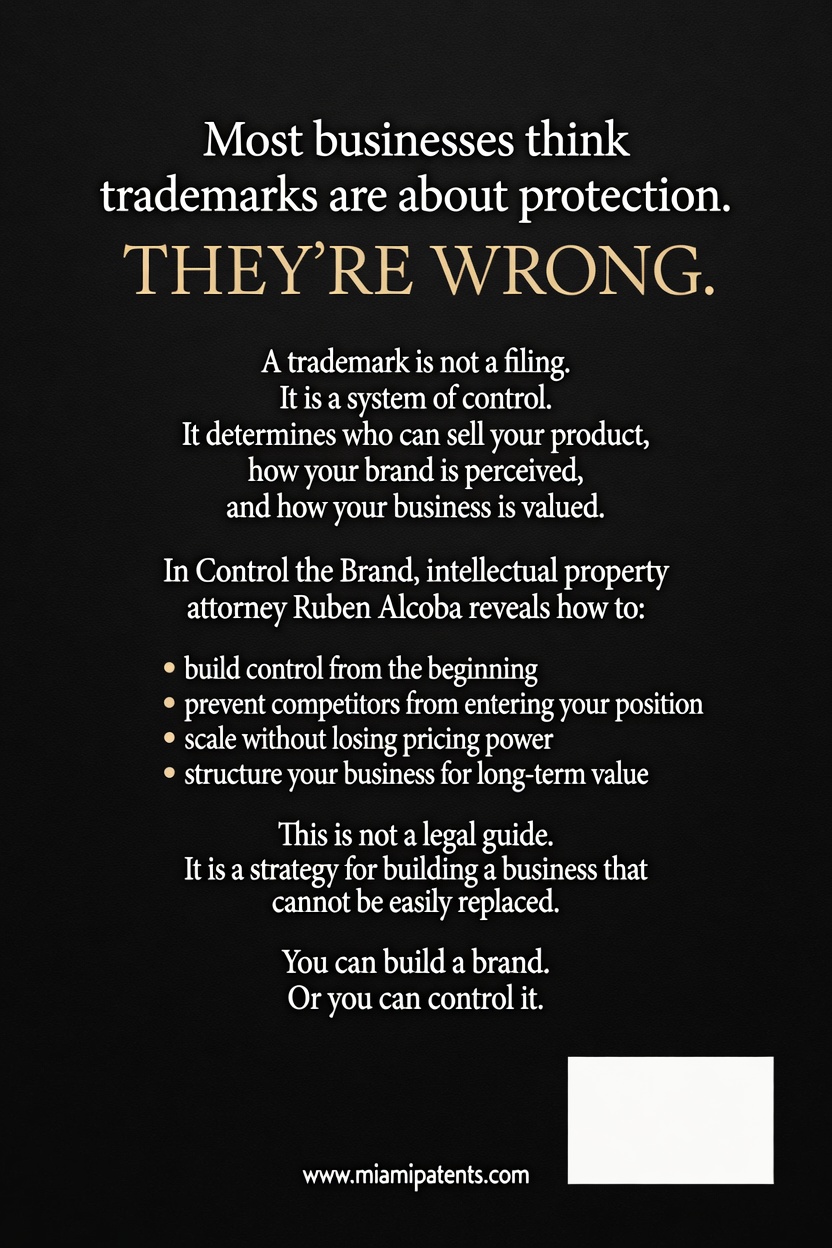
A trademark is not protection.
It is control.
That is the strategic position of the book. It is not presented as a procedural legal guide, but as a framework for controlling pricing, distribution, licensing, expansion, and long-term business value.
Why this message converts
The strongest copy already exists inside your materials. The book one-sheet frames the trademark as a system of control, and the free chapter shows how that system plays out in Amazon Brand Registry, pricing, enforcement, and ownership. That makes the site more than a book page. It becomes a positioning funnel.
Move beyond protection language
The book one-sheet says the trademark shapes market behavior, pricing power, distribution access, and long-term business value.
Show where businesses lose control
The “Top 10 Trademark Mistakes” document turns the message into pain: weak names, loose distribution, bad ownership structure, and waiting too long to build the system.
Use the rules to establish authority
The “Top 10 Brand Control Rules” document gives the executive-level answer: control access, enforce consistently, structure ownership correctly, and treat the brand as the asset.
Control, not just filing
- Why trademarks control markets, not just names
- How Amazon Brand Registry fits into a larger strategy
- How businesses lose control through weak structure
- Why ownership affects valuation and leverage
- How licensing and distribution shape pricing power
Built for founders and brand owners
- Amazon sellers dealing with listing pressure and unauthorized sellers
- Founders preparing for growth, partnerships, or licensing
- Businesses trying to protect pricing and market position
- Owners thinking about valuation, investment, or sale
- Companies that want the brand to function as a real asset
Get the free chapter
The free chapter uses Amazon Brand Registry to show one of the most important ideas in the book: Amazon is not the strategy. It is only a tool, and its effectiveness depends on the clarity, consistency, and structure behind the trademark itself.
- Strong hook for Amazon sellers and product brands
- Shows the difference between effort and precision
- Moves the reader naturally toward the full book
Send me the free chapter
Use your actual form endpoint here. After submission, redirect the user to /thank-you.html.
Featured chapter themes
The early content already gives you high-conversion topic blocks. The free chapter shows that Brand Registry is not protection but a tool that only works when the underlying mark is strong, clear, and supported by evidence. That is exactly the kind of insight that makes visitors trust the deeper framework.
Brand Registry is not protection
The free chapter states that Amazon does not create rights and does not guarantee enforcement. It reacts to clarity, consistency, and evidence tied to an enforceable trademark position.
Strong brands reduce comparison
The book’s broader message is that when a trademark carries meaning, pricing becomes less sensitive, competitors hesitate, and the business gains structural advantage.
Who owns the mark matters
The framework ties trademark ownership directly to leverage, negotiation strength, and long-term value when investors, partners, or buyers evaluate the business.
Expansion without structure is loss of control
The materials consistently show that growth without boundaries weakens the brand. Licensing, distribution, and access all need structure if the name is going to retain value.
Get the supporting resources
Use these as secondary lead magnets, consultation follow-ups, and authority pieces for LinkedIn, email, and client outreach.
Top 10 Trademark Mistakes
This PDF is the fear-based version of the system. It explains how businesses lose control through weak marks, inconsistent branding, bad ownership structure, and uncontrolled distribution.
Download PDFTop 10 Brand Control Rules
This PDF is the executive-level version. It turns the strategy into rules: treat the brand as the asset, control who sells under it, structure ownership correctly, and enforce with precision.
Download PDFControl the Brand One-Sheet
This summary piece gives the strategic position, key takeaways, audience, author authority, and action path to Amazon and legal strategy support.
Download PDF
Ruben Alcoba, Trademark Attorney & Author
Ruben Alcoba is the author of Control the Brand and a trademark attorney with over 25 years of experience advising businesses on brand protection, intellectual property strategy, and market positioning.
The authority here comes from years of legal work translated into a business framework founders can use before expansion, licensing, or sale.
You can build a brand. Or you can control it.
The difference shows up in pricing, expansion, licensing, buyer confidence, and valuation. Read the free chapter, get the book, and if the brand already matters, structure it correctly before problems get expensive.